Waveform

The Waveform scope plots signal levels vertically against the horizontal position of each pixel in the frame. Use it to judge exposure, balance channels, and spot illegal levels at a glance.

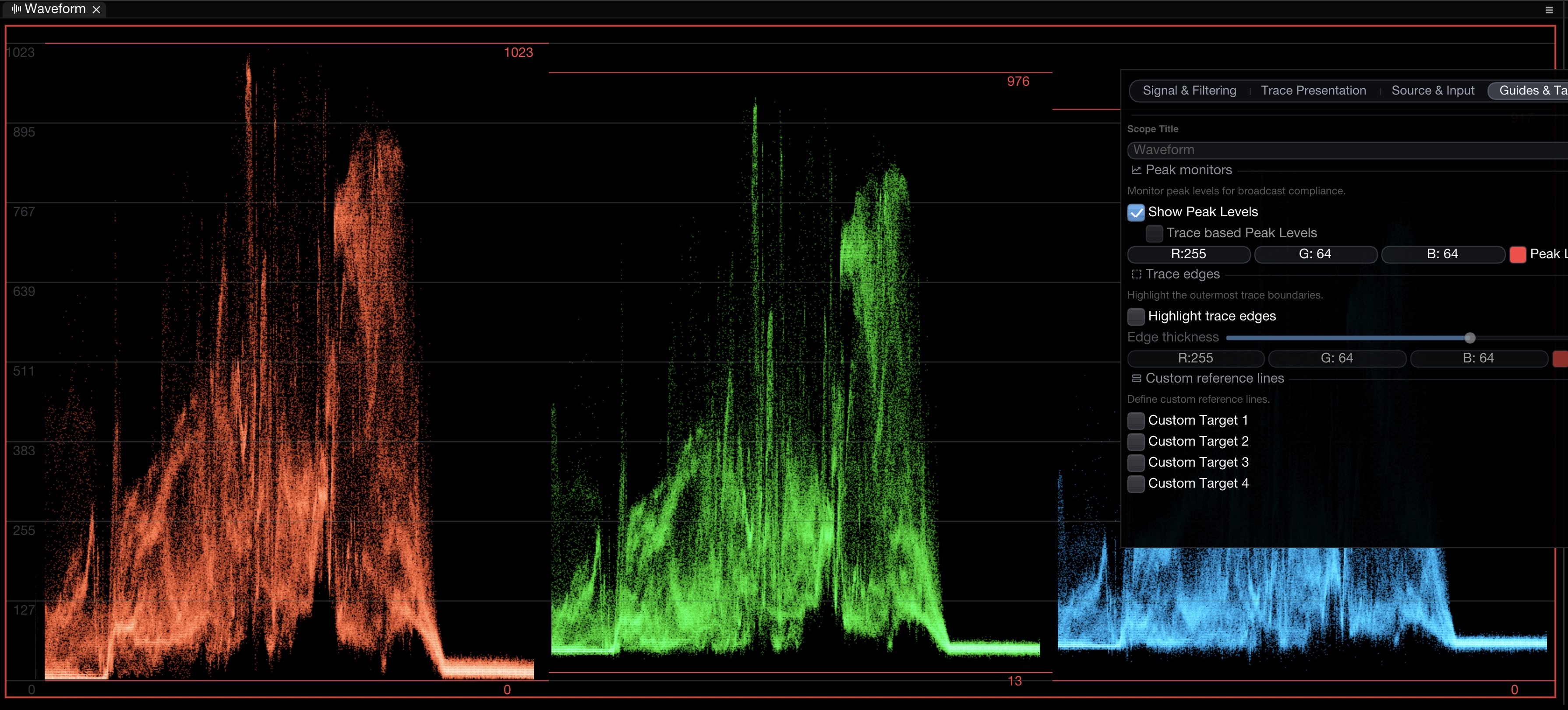
Waveform scope in RGB Parade mode

Display Modes

Mode
Description

Luminosity

Single luma trace (Rec. 709 weighted)

RGB

R, G, B overlaid on the same area. Individual channels can be toggled on/off.

RGB Parade

R, G, B side by side with configurable spacing

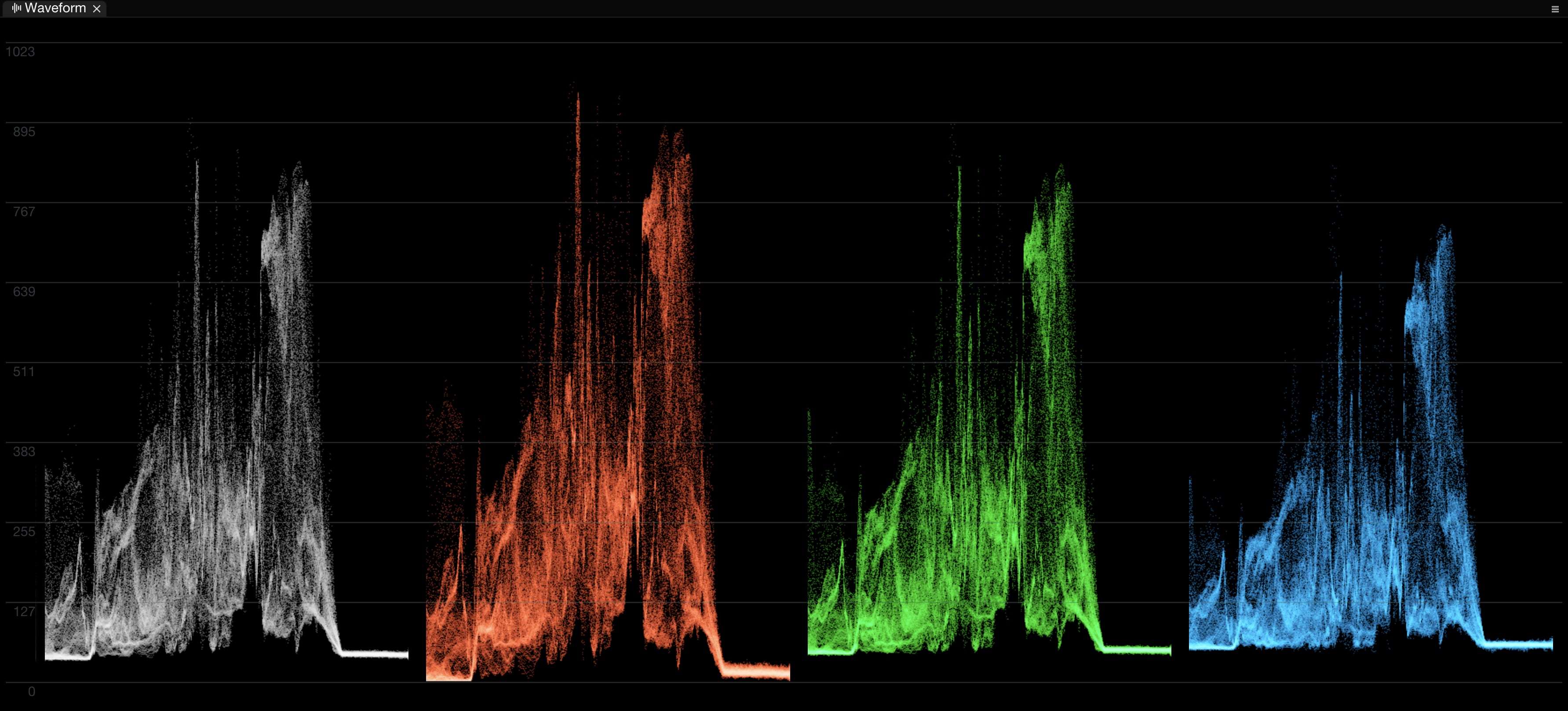
YRGB Parade

Y, R, G, B side by side

YCbCr Parade

Y, Cb, Cr side by side

Each mode can be colorized — in luma mode this applies HSV-based colouring, in parade modes each channel is tinted with its own colour.

Scale

Scale
Range

IRE

0–100

Percentage

0–100 %

8-bit

0–255

10-bit

0–1023

PQ ST 2084

0–10 000 nits (logarithmic)

HLG

0–1 000 nits (logarithmic)

mV

50–700 mV

The scale follows the input source by default. Enable Scale override in the scope settings to choose a different scale per scope.

Legal range lines — when enabled, lines are drawn at legal code values (for example 64/940 in 10-bit and 16/235 in 8-bit).

HDR / PQ Scale

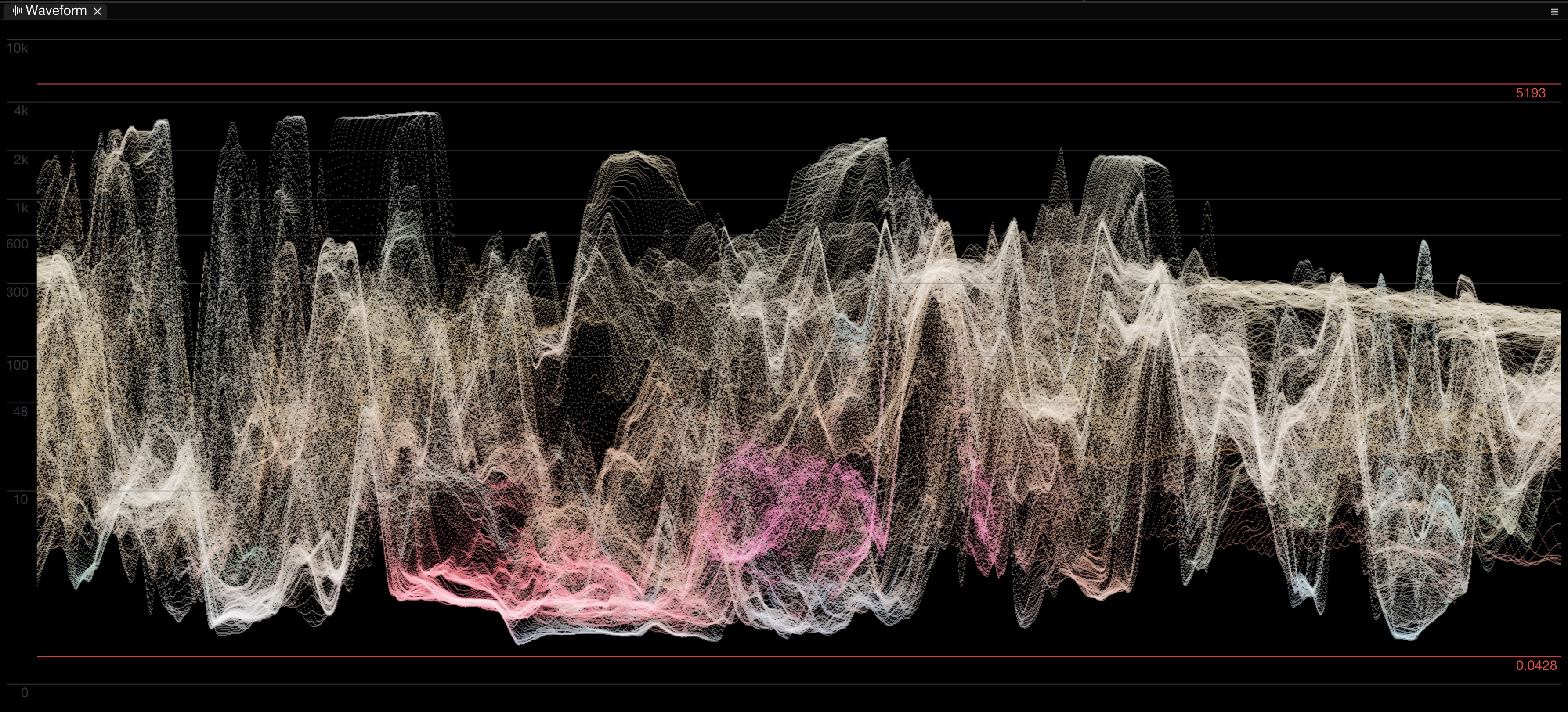
When using PQ or HLG scales, adjust the Mastering Level slider to zoom into a specific nit range. Double-click to reset to the maximum value. Reference graticules at standard HDR levels (26, 203, 1 000 nits) help align HDR deliverables.

Waveform with PQ ST 2084 nit scale

Trace Presentation

Setting
Description

Gain

Master trace brightness (1–100 %)

Enhance Edges

Lifts fine detail in the trace for better visibility

True RGB colours

Use pure red/green/blue instead of shaded trace colours

Smooth Trace

Light temporal/post smoothing to reduce speckle noise

Enhanced Render

Use line-strip rendering instead of point rendering

Highlight Trace Edges

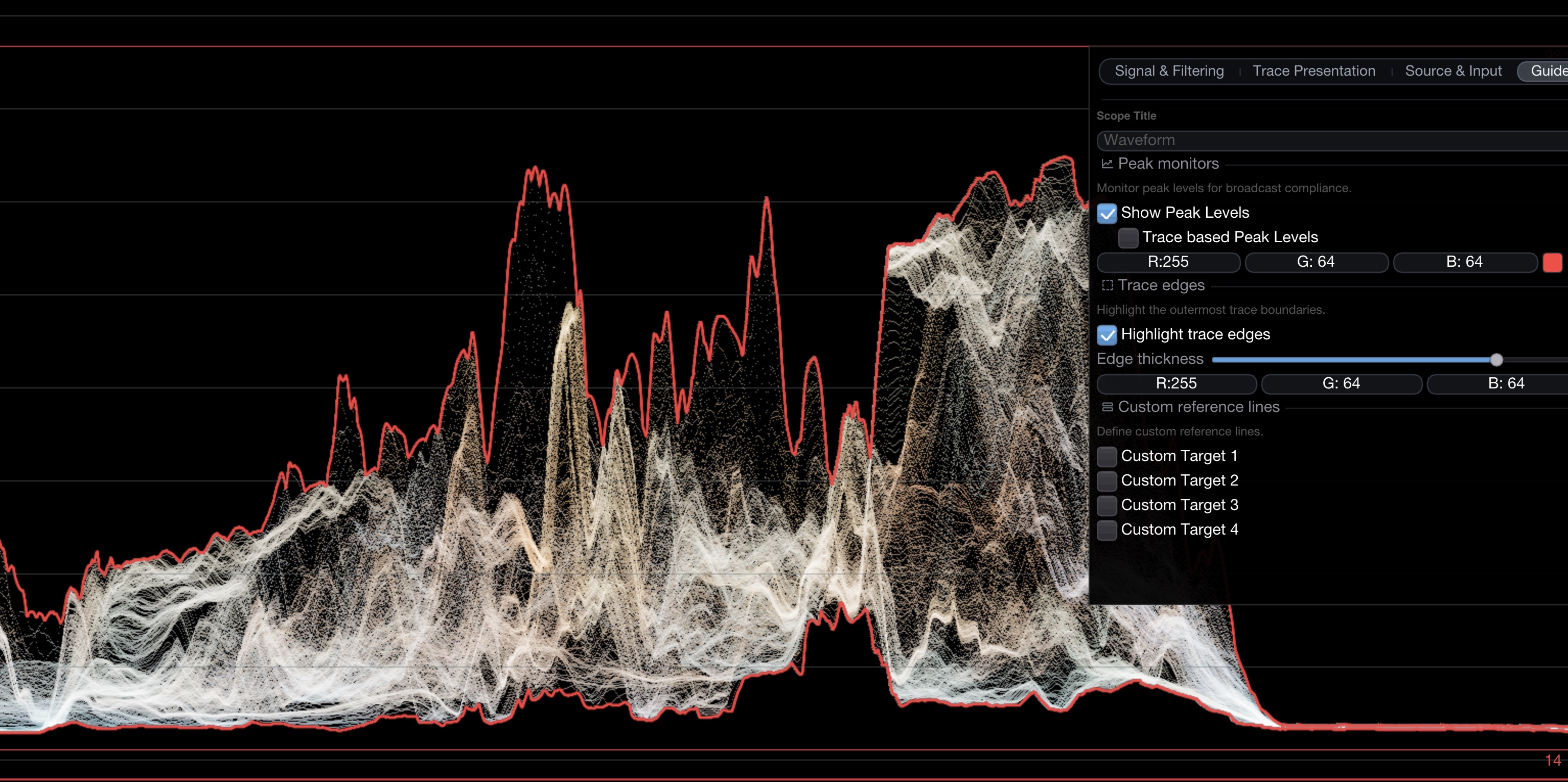
Render coloured outlines at the outermost boundaries of the waveform trace — useful for quickly spotting signal extent and comparing shots.

Highlight trace edges showing signal boundaries
Setting
Description

Edge thickness

0.5–3 px

Edge colour

Customisable (default: red)

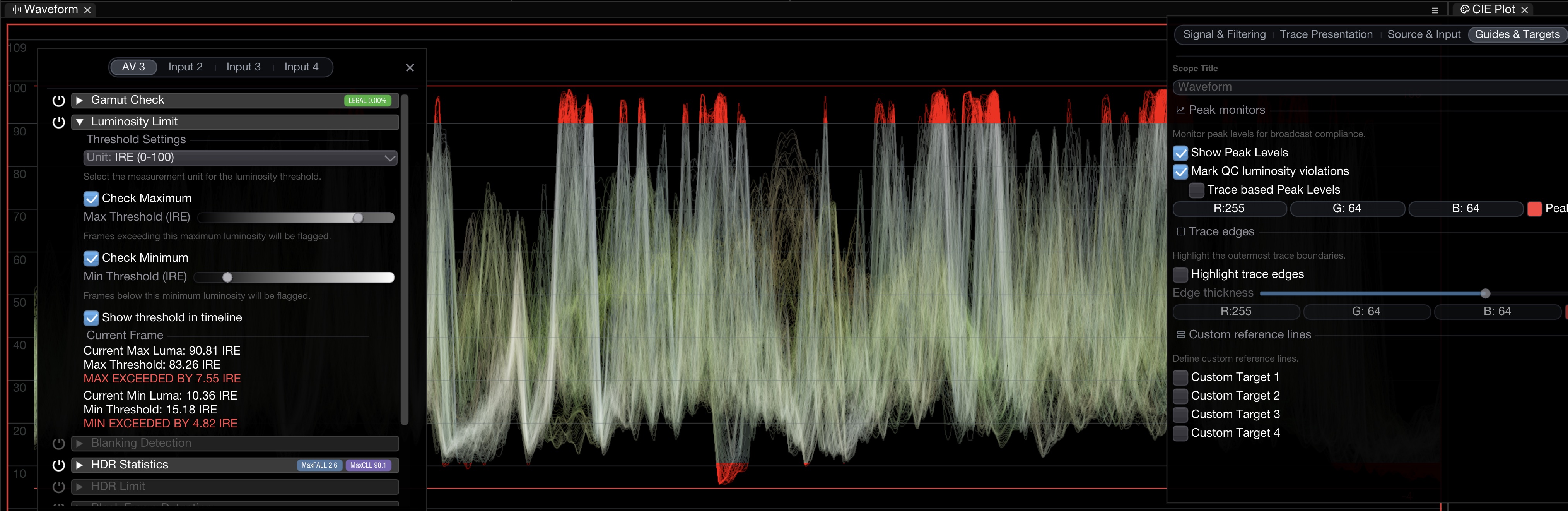
Mark QC Luminosity Violations

When the Luminosity Limit QC check is enabled, turn on Mark QC luminosity violations to render luma trace samples in red wherever they exceed the configured min/max thresholds. This gives an immediate visual indication of out-of-range levels directly on the waveform.

Luma trace samples exceeding the QC luminosity limit highlighted in red

Requires at least one min or max check to be active in the Luminosity Limit QC panel.

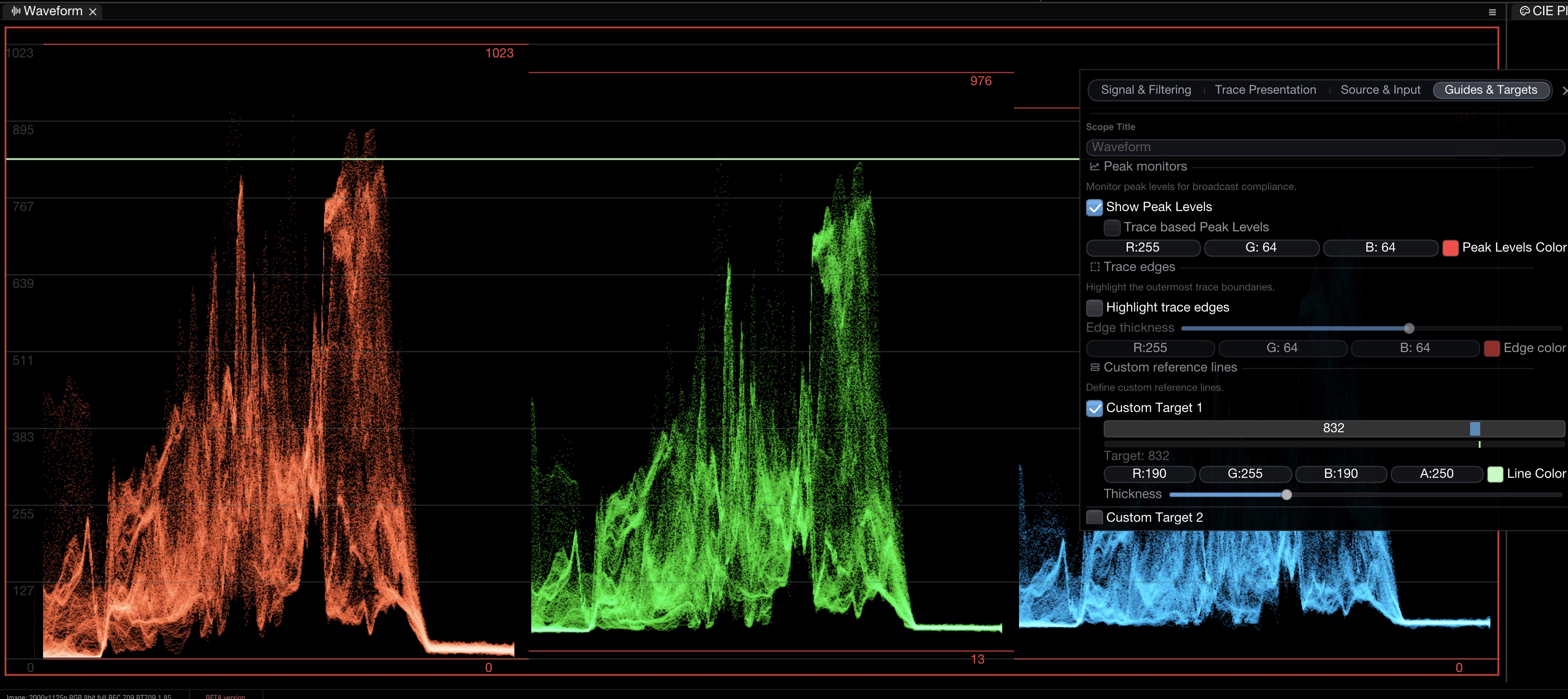
Peak Levels

Peak level indicators show the minimum and maximum signal values for each channel as numeric readouts with horizontal marker lines.

Peak level indicators on the waveform
Setting
Description

Show Peak Levels

Enable/disable the indicators

Trace-based Peak Levels

Derive peaks from the rendered trace shape instead of image statistics (Luminosity and RGB modes only)

Peak Levels colour

Customisable line and text colour

In parade modes, peak levels are shown per channel.

Zoom

Zoom vertically into shadows or highlights for detailed inspection.

Input
Action

Mouse wheel

Zoom in/out (0.5×–20×)

Middle-click or Double-click

Reset zoom to 1×

Context-menu presets for quick zoom levels:

  • 0–20 IRE (5×) · 0–15 IRE (7.5×) · 0–10 IRE (10×)

Toggle between zoom shadows (default) and zoom highlights to target the range of interest. In video range mode the view automatically centres on legal black or legal white.

Adaptive Scale

The waveform scale adapts its granularity to the current zoom level — the more you zoom in, the more intermediate scale values appear. This keeps the readout useful at every magnification without cluttering the view when zoomed out.

Custom Targets

Up to 4 per-scope reference lines at specific signal levels — useful for marking black points, white points, or exposure targets.

Custom targets with numeric labels
Per-target setting
Description

Value

Adapts to the current scale (IRE, 8-bit, 10-bit, nits, etc.)

Colour

Customisable per target

Thickness

1–5 px

Targets can be dragged directly on the waveform for quick repositioning.

Global Target Sets

Global targets provide a shared set of luma reference lines that appear across all waveform and parade scopes. Toggle individual targets, adjust colours and thickness, and save/recall target sets for different projects or standards.

Filtering

Setting
Description

Waveform Low-Pass filter

Horizontal box blur that softens the trace. Adjustable kernel size (0.5–20).

Signal Low-Pass filter (EBU R103)

Uses EBU R103 pre-filtered input. Requires the filter to be enabled globally in Preferences.

Broadcast Workflow Notes

Practical guidance from an industry waveform/vectorscope primer:

  • Use waveform as the primary legal-range check: keep most luma in legal range and allow only controlled specular excursions per delivery spec.

  • In digital workflows, setup is typically not used; legacy analog NTSC workflows may still reference 7.5 IRE setup.

  • For balancing, pair RGB Parade with Vectorscope: parade for channel level alignment, vectorscope for hue/saturation verification.

Layout & Spacing

Setting
Description

Channel spacing

Gap between parade channels (0–30 px). Only active in parade modes.

Top & Bottom margin

Vertical margin (0–100 px)

Left margin

Space for the scale labels

16:9 ratio

Lock the scope aspect ratio to 16:9

Color Pins

When colour pins are placed on the Source Signal viewer, they are reflected on the waveform:

  • Luma / RGB modes — circle at the pin's horizontal position and luma value

  • Parade modes — circles in each channel lane at the respective R, G, B values

  • Hovering a pin draws a horizontal line at its luma level

Keyboard Shortcuts

macOS
Windows
Action

Mouse wheel

Mouse wheel

Zoom in/out

Middle-click

Middle-click

Reset zoom

Alt (hold)

Alt (hold)

Morph between waveform and source image

StreamDeck / Action Editor

Action
Description

WaveformZoomBlacks

Cycle zoom presets for shadows (5×/7.5×/10×/1×). Also supports continuous dial control.

WaveformZoomWhites

Cycle zoom presets for highlights

WaveformTogglePeakLevels

Toggle peak level indicators

Last updated