> For the complete documentation index, see [llms.txt](https://docs.timeinpixels.com/llms.txt). Markdown versions of documentation pages are available by appending `.md` to page URLs; this page is available as [Markdown](https://docs.timeinpixels.com/nobe-omniscope/qc/blanking-detection.md).
# Blanking Detection
Blanking Detection finds black borders around active picture content (letterboxing and pillarboxing) and can also handle slightly rotated content.
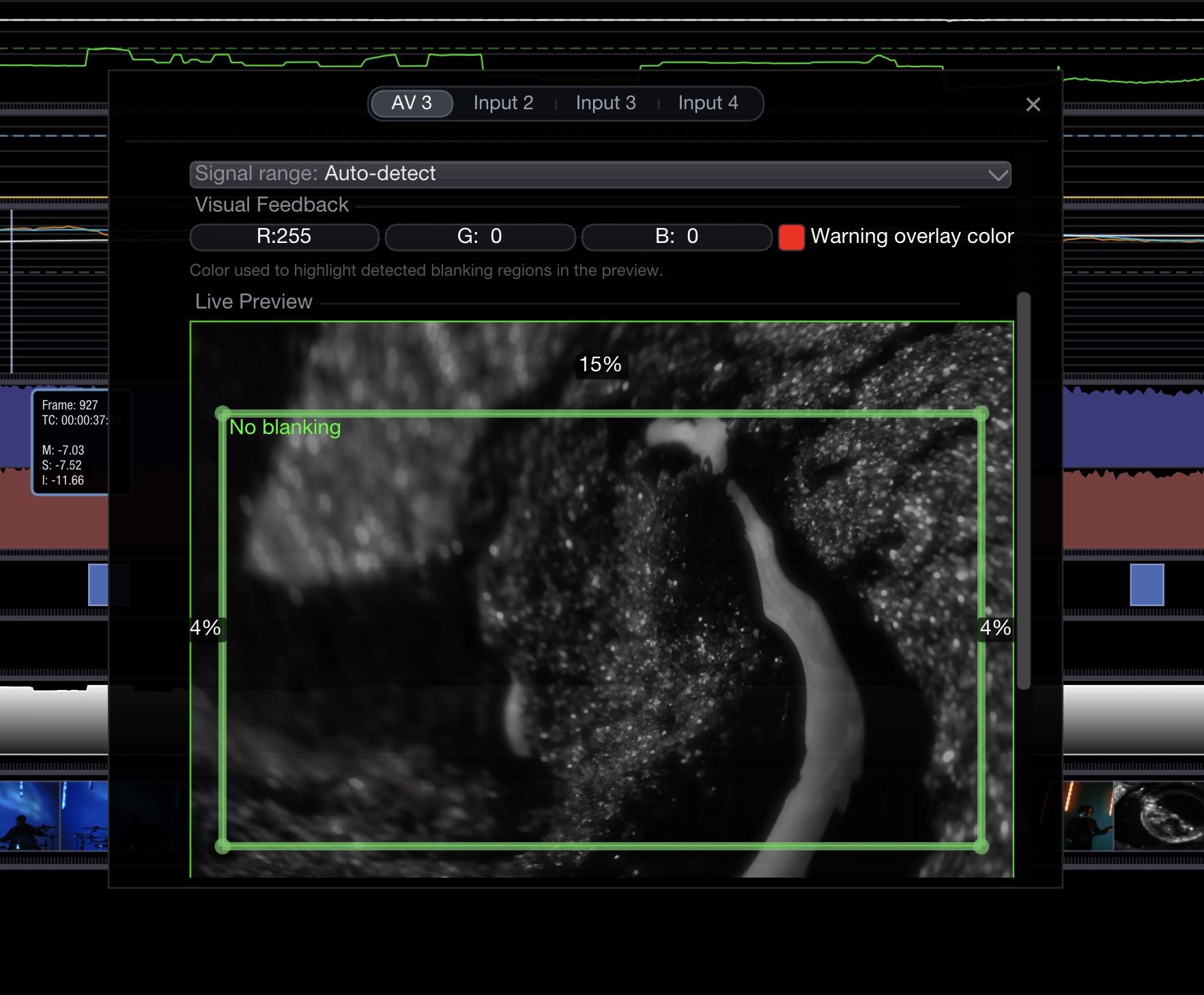
Blanking Detection highlighting detected borders
## What It Detects
* Top, bottom, left, and right blanking depth
* Rotated blanking patterns (for example, corner triangles)
* Optional overlay warnings directly in the viewer
## Where to Enable It
1. Open the **QC** panel.
2. Enable **Blanking Detection**.
3. Adjust margins and thresholds as needed.
## Settings
### Detection Margins
Set how far from each edge OmniScope should search for blanking.
### Threshold Mode
| Mode | Typical Use |
| ------ | ----------------------- |
| Auto | Most workflows |
| Full | Full-range signals |
| Video | Video-range signals |
| Custom | Manual threshold tuning |
In **Custom** mode, set R/G/B thresholds manually.
### Warning Color
Set the overlay color used when blanking is detected.
## Results and Feedback
* Overlay is drawn in the source viewer when blanking is detected.
* QC status shows active detections in real time.
* Rotation information is shown when rotated blanking is detected.
* Events are available in QC timeline workflows.
## Aspect Ratio Awareness
Blanking detection runs after input aspect-ratio handling, so letterboxed content inside another container can still be detected correctly.
## Troubleshooting Tips
* If dark scenes trigger false positives, tighten margins and/or raise thresholds.
* If rotated content is under-detected, widen margins slightly.
* If overlays are hard to see, switch to a higher-contrast warning color.
## Demo
{% embed url="" %}