> For the complete documentation index, see [llms.txt](https://docs.timeinpixels.com/llms.txt). Markdown versions of documentation pages are available by appending `.md` to page URLs; this page is available as [Markdown](https://docs.timeinpixels.com/nobe-omniscope/action-editor.md).
# Action Editor
Configuration manager for keyboard shortcuts and StreamDeck actions
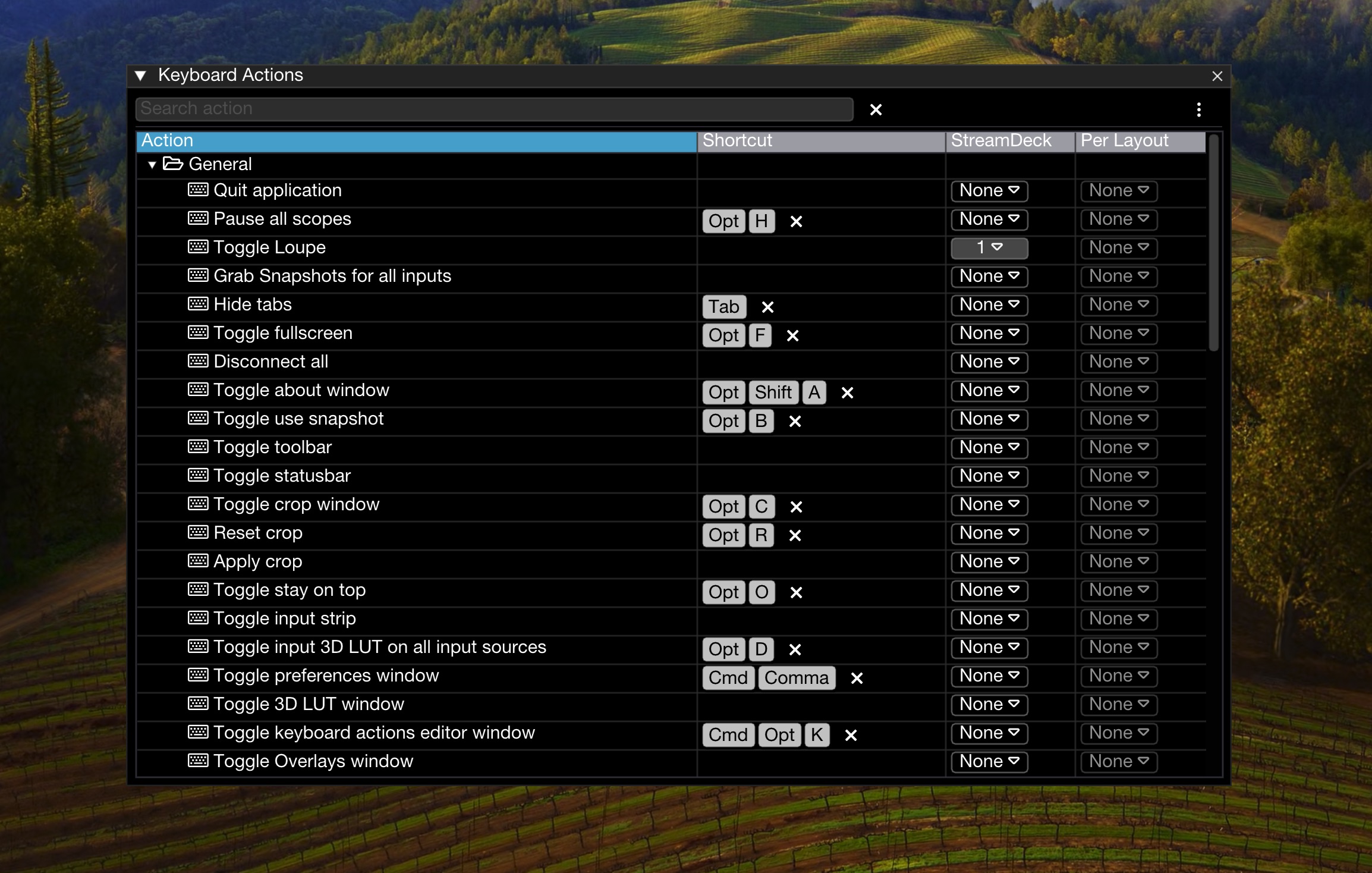
The Action Editor provides a centralized interface for configuring keyboard shortcuts and StreamDeck panel mappings. It is designed for professionals in demanding workflows where quick, efficient actions are essential.
Action Editor
## Action Categories
The Action Editor organizes actions into intuitive categories:
* **General Actions** — Straightforward actions that don't require additional parameters, ideal for quick and routine tasks.
* **Input Device Actions** — Assign specific devices to desired input slots, essential in multi-device environments.
* **Layout Actions** — The **Load Layout** action accepts two parameters: layout index or name, making it easy to switch between different layouts.
* **Input Slot Actions** — Assign actions to specific input slots, ensuring accurate responses from the intended device. Particularly useful in complex multi-input setups.
* **Scope Actions** — Each action is linked to a unique scope identifier, visible in the Action Editor. This allows precise control over multiple scopes.
* **Timeline Navigation Actions** — Direct actions for **Go to Frame** and **Go to Time**, enabling precise timeline jumps from shortcuts, Stream Deck, and integrations.
* **Input Settings Actions** — Expose source settings directly through the Action Editor and integrations.
## User-Friendly Features
* **Preview of Scope Index** — View the scope index by pressing **Alt+Shift** (or **Opt+Shift** on macOS), even when the Action Editor is closed. This aids in fast scope identification.
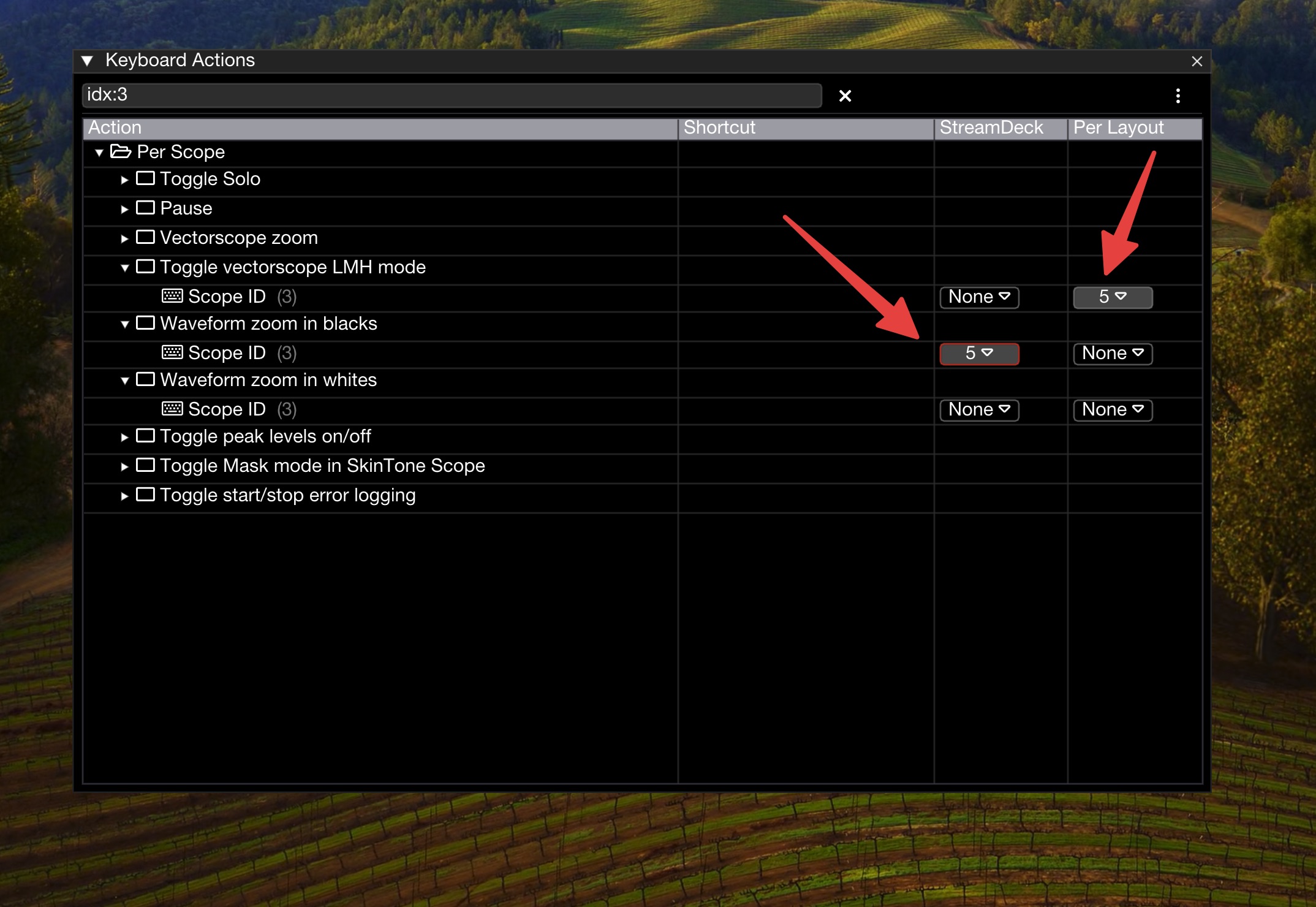
* **Action Filtering** — Narrow down actions for a specific scope using the search box. For example, typing **`idx:3`** filters actions exclusively for scope index 3.
Filtering actions by scope index
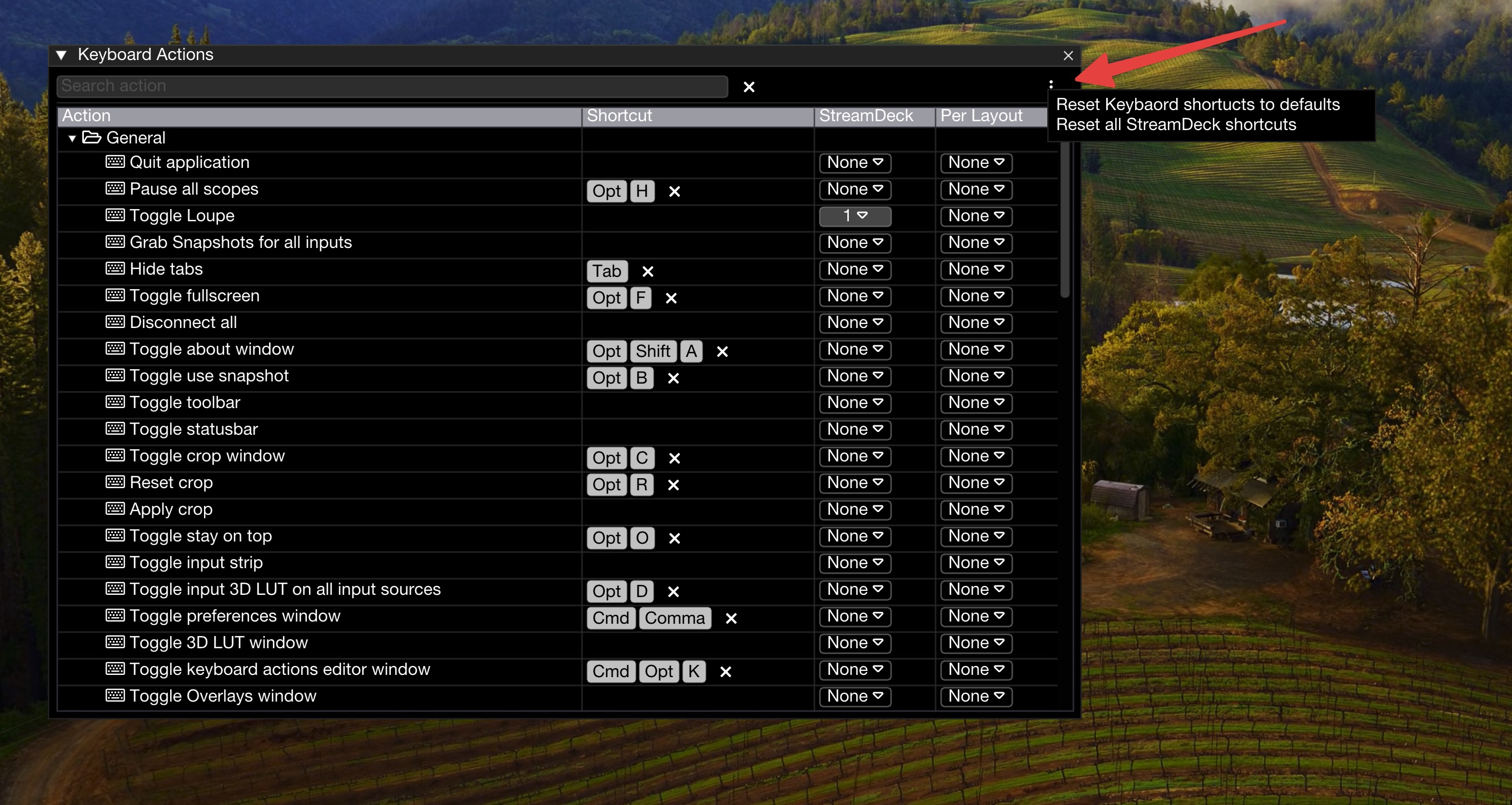
* **Clearing the mappings** — Use the "3 dots" menu to reset existing mappings and start from scratch:
Reset mappings menu
## Assigning Keyboard Shortcuts and StreamDeck Actions
* **Keyboard Shortcuts** — Click the action name to record a new shortcut. OmniScope will notify you if the chosen shortcut is already in use, preventing conflicts.
Recording a keyboard shortcut
* **StreamDeck Actions** — Two columns in the editor, **StreamDeck** and **Per Layout**, provide flexibility in mapping. Global mappings apply across all layouts, while Per Layout mappings are specific to the current layout and override global mappings when active.
StreamDeck global and per-layout mappings
* **Keyboard shortcuts** are automatically displayed in the macOS menus:
Shortcuts in macOS menus
## Application Protocol
OmniScope supports invoking actions programmatically using the custom URI scheme **`omniscope://`**. This enables workflow automation and integration with scripts, macros, or third-party applications.
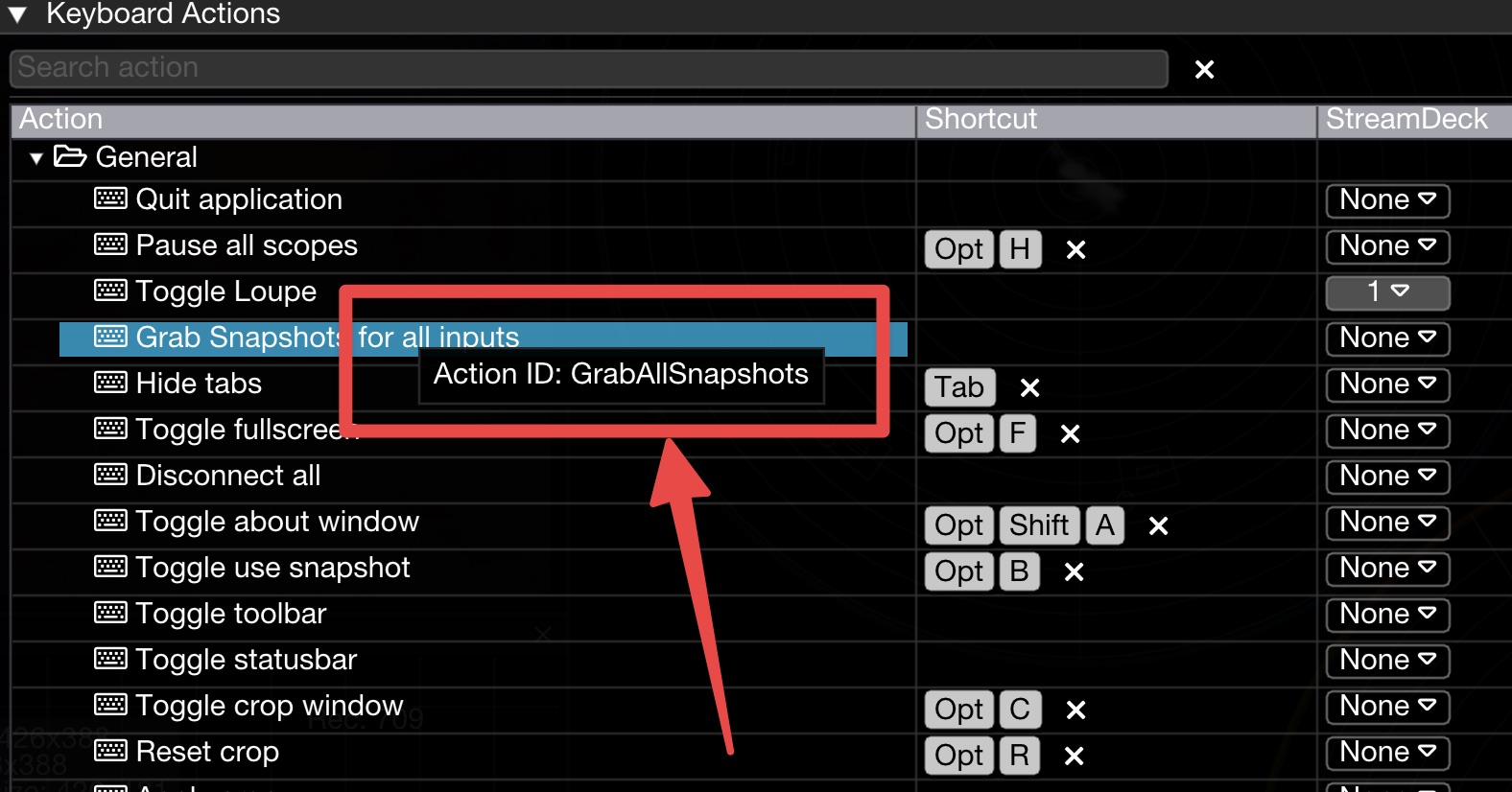
Format: **`omniscope://action?id=ActionID¶m=ActionParam`**
The **ActionID** can be found by hovering over the action in the editor: